Python regius · Pythonidae
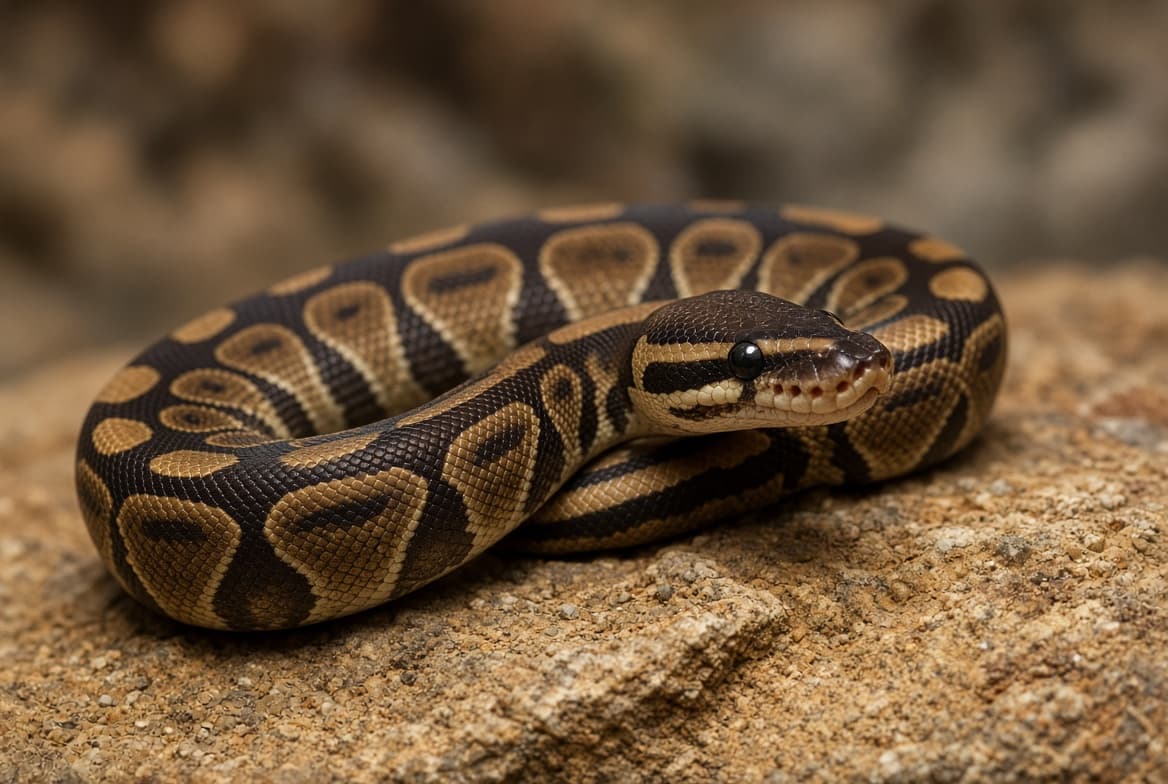
Ball Python
A calm, compact African python that curls into a ball when nervous. Small enough for a standard enclosure, with a long life and an enormous range of color morphs.
- Group
- Snakes
- Difficulty
- Beginner
- Adult size
- 3–5 ft (rarely a little over 5 ft); females larger
- Lifespan
- 20–30 years
Evidence CExpert consensus or hobby source (lowest grade of its care-critical sections) · Reviewed 2026-10-24 by Novel Fauna · Evidence graded 2026-10-25
Overview
- Only expert, clinic or hobby sources
Ball pythons (royal pythons) are modestly sized, easygoing snakes and among the most popular reptiles kept 12. Most adults are 30 to 45 inches, rarely reaching five feet or a little more, and females outgrow males 14. They are not large constrictors: an adult fits comfortably in a standard reptile enclosure. They can live twenty to thirty years with good care, so plan for the long haul 2.
Natural history
- Only expert, clinic or hobby sources
Ball pythons come from the grasslands and savannas of West and Central Africa, especially Ghana, Togo, Benin and Ivory Coast 12. They shelter in burrows and termite mounds to shed and escape the heat, and they do well in farmland, where rodents are plentiful 2. Wild balls eat mostly small rodents 2. They are nocturnal 2. In parts of their range, especially Ghana, they are revered and protected. Elsewhere they are collected for the meat, leather and pet trades 2.
Enclosure
- Only expert, clinic or hobby sources
- Babies. A 10-gallon enclosure (about 12 × 20 in) or a ventilated tub. Many young balls feel more secure in smaller spaces 12.
- Adults. A 20- to 30-gallon enclosure (about 15 × 36 in) works for life 1. CEX encourages custom enclosures of at least 3 ft × 2 ft × 18 in, since bigger is better for adults 2.
- Escape-proof. All ball python enclosures must lock securely 1.
- Hides. Two snug hides, one warm and one cool, no more than about 50% bigger than the snake. Make one a humid hide with damp sphagnum 1.
- Enrichment. Low branches, dried leaves or hay for new scents, and an occasional rearrangement of décor 2.
- Water. A sturdy bowl big enough to climb into 1.
Temperature & lighting
- Only expert, clinic or hobby sources
| Target | |
|---|---|
| Cool end | 78–80°F 1 |
| Warm end | 85–90°F 1 |
| Hot spot | 88–92°F; never above 92°F 2 |
Heat with an under-tank mat, radiant heat panel or ceramic emitter, always on a thermostat. Uncontrolled heat pads cause serious belly burns 12. Never use hot rocks 1.
UVB is not essential, but full-spectrum lighting with a low (2–5%) UVB output for 10 to 12 hours a day can help regulate daily rhythms 12.
Humidity
- Only expert, clinic or hobby sources
Keep humidity at 50 to 70%. Ball pythons do poorly in dry air. Raise it to about 70% during a shed so the skin and eye caps come off cleanly 12.
Substrate
- Only expert, clinic or hobby sources
Cypress mulch, coco fiber or coconut husk hold humidity well. Aspen or newspaper work if you watch humidity 12. Never use pine or cedar, whose aromatic oils irritate snakes 2. Spot-clean promptly, and replace all substrate at least every two months 1.
Diet & supplementation
- Only expert, clinic or hobby sources
- Prey. Appropriately sized mice or small rats, no wider than the snake's widest point 12.
- How often. Weekly for young snakes, every one to three weeks for adults. Ball pythons become obese easily 12.
- Pre-killed only. Frozen-thawed prey is safest. Live rodents can injure or kill a snake, so never leave one unattended with live prey 12.
- Supplements. None are needed when feeding whole prey 1.
Fasting is normal. Healthy adult males often stop eating from about October to February 1. Weigh your snake. Losing more than 10% of body weight means it is time for a vet visit 1.
Handling & temperament
Ball pythons are named for their habit of curling into a tight ball, and their easygoing temperament is a big part of their popularity 23. Socialized balls are often friendly with their families 3. Avoid handling right after a meal, since handling after feeding is a common cause of regurgitation 2. Wash your hands after handling or feeding: reptiles and frozen feeder rodents can both carry Salmonella 9.
Health
- Only expert, clinic or hobby sources
Common issues
- Respiratory infections. Wheezing, open-mouth breathing and mucus are common in snakes. Low temperatures and dirty enclosures predispose snakes to them 27.
- Regurgitation from wrong temperatures, overfeeding or handling after a meal 2.
- Snake mites, tiny black mites that can spread between enclosures in the same room 28.
- Intestinal parasites, especially in imported animals. An annual fecal exam is recommended 2.
- Stuck shed and retained eye caps in low humidity 2.
- Burns from heat pads without a thermostat 2.
- Obesity 1.
When to see a vet
See a reptile vet for weight loss of more than 10%, wheezing or mouth discharge, lumps, loose stools or repeated stuck sheds 12. Get help right away for burns 2, and treat open-mouth breathing or an unresponsive snake as an emergency 10. Quarantine new snakes for three to six months before they join a collection 2.
Breeding overview
- Rests on a single source
- Only expert, clinic or hobby sources
Ball pythons mature at two to four years when well fed 2. Breeders usually cycle them in autumn with slightly cooler nights, and females typically lay six or seven eggs 2. Sexing by probing should be done by an experienced keeper or a vet, because poor technique causes injury 2.
Genetics & morphs
Selective breeding has produced many color and pattern morphs, including pieds, albinos, cinnamons, clowns and bananas 12. Morph prices range from about the cost of a normal ball to several thousand dollars for rare combinations 3.
The spider morph has a known welfare problem. In a 2022 study, every spider morph snake examined had the "wobble" condition (head twisting, impaired movement, trouble striking and constricting), associated with malformed inner-ear balance organs 5. Novel Fauna does not recommend producing spider or spider-combination morphs.
Legal & ethics
Python regius is listed on CITES Appendix II, so international trade needs export permits 6. Many ball pythons are still exported from West Africa, and wild-caught animals usually carry heavy parasite loads 12. Choose captive-bred snakes.
Sources
- Ball Python Care · Tree of Life Exotic Pet Medical Center
- Ball Python Care · Chicago Exotics Animal Hospital
- Ball Python Care Sheet · PetMD
- Python regius (Ball Python, Royal Python) · Animal Diversity Web, University of Michigan
- Malformations of the sacculus and the semicircular canals in spider morph pythons · PLOS ONE
- CITES listing: Python regius · Species+ (UNEP-WCMC and CITES Secretariat)
- Respiratory Infections in Snakes · Tree of Life Exotic Pet Medical Center
- Mites in Reptiles · Tree of Life Exotic Pet Medical Center
- Salmonella, Feeder Rodents, and Pet Reptiles and Amphibians · U.S. Food and Drug Administration
- When Should My Reptile See a Veterinarian? · Tree of Life Exotic Pet Medical Center
Last reviewed 2026-10-24 by Novel Fauna. This guide is general husbandry information, not veterinary advice. When an animal is sick, see a veterinarian experienced with exotic animals.
Revision history
- Library: 50 cited care guides, /library/[slug] route, coming-soon cards, SLUGS.txt synced to species.guide_slug
228ce54
Evidence grades: Novel Fauna editorial: source classification, not yet expert-reviewed, 2026-10-25. What the grades mean.