Pogona vitticeps · Agamidae
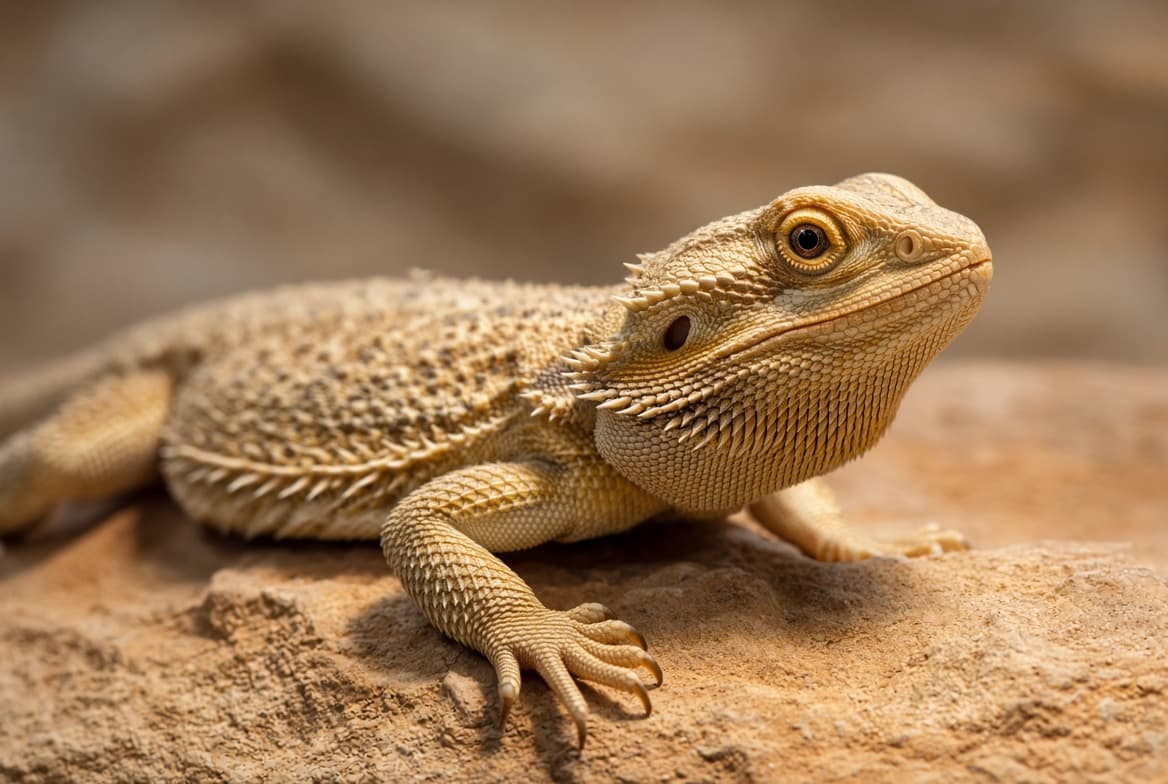
Bearded Dragon
A sun-loving, even-tempered lizard from inland Australia. A long enclosure with a hot basking spot, strong UVB, and a diet that shifts from insects to greens as it grows.
- Group
- Lizards
- Difficulty
- Beginner
- Adult size
- up to about 2 ft (60 cm) including the tail; 250–550 g
- Lifespan
- 8–12 years, often longer with good care
Evidence CExpert consensus or hobby source (lowest grade of its care-critical sections) · Reviewed 2026-10-24 by Novel Fauna · Evidence graded 2026-10-25
Overview
- Only expert, clinic or hobby sources
The central, or inland, bearded dragon is one of the best lizards for a first-time keeper who is ready to set up the enclosure properly. Adults are calm, active by day, and usually tolerate handling well 78. The care is not hard, but three things are not optional: a hot basking spot with a real temperature gradient, UVB lighting, and a diet that changes with age 125.
Expect eight to ten years as a baseline, with twelve or more now common in well-kept animals 78.
Natural history
Pogona vitticeps lives in the arid and semi-arid interior of eastern and central Australia 269. The name comes from the spiny throat pouch, the "beard," which the dragon puffs out and darkens in defensive and social displays 56. Wild dragons bask on logs, posts and rocks, eat whatever insects and plants they can find, and slow down through the cool winter months in a resting state called brumation 24.
Males are usually a little larger, with hemipenal bulges, larger femoral pores and a more developed beard 5. Pet dragons outside Australia are all captive bred; wild animals are no longer imported 5.
Enclosure
- Size. A juvenile can start in a 20-gallon tank, but an adult needs much more room 17. LafeberVet sets a 75-gallon minimum for one adult 6, and VCA recommends 60 to 100 gallons or larger 1. A good rule from both: the enclosure should be at least three times as long as the dragon, and at least 16 inches wide so it can turn easily 16.
- Top and ventilation. Well ventilated with a secure lid 1.
- Furnishings. Hides at both ends, plus branches and ledges to climb and bask on 5.
- One per enclosure. Ask your veterinarian before housing dragons together 1. Most keepers house adults singly.
Temperature & lighting
| Zone | Target |
|---|---|
| Basking spot | 98–105°F (37–41°C) 5 |
| Warm end | 85–90°F 5; VCA allows the warm end up to 100°F 1 |
| Cool end | 75–80°F (24–27°C) 1 |
| Night | lights off; 65–80°F is fine without extra heat 1 |
Measure with one thermometer at each end, plus an infrared thermometer for the basking surface 1. Run heat through a thermostat and skip heat rocks, which burn 58. Dragons warm up fast but cool slowly, so they can overheat if they cannot get away from the lamp 6.
UVB is essential. Bearded dragons need UVB to make vitamin D3 and use calcium; without it they develop metabolic bone disease 35. Use a reptile UVB lamp (a high-output fluorescent tube or a mercury vapor bulb made for reptiles) for 10 to 12 hours a day 57. UVB output fades long before the visible light does, so replace bulbs on the maker's schedule, usually every 6 to 12 months 57. A plain heat bulb does not necessarily provide UVB 1.
Humidity
- Only expert, clinic or hobby sources
Bearded dragons are arid animals. Keep humidity fairly low, roughly 30 to 50% 7; Chicago Exotics allows up to 60% 8. A shallow water dish large enough to climb into, plus regular warm soaks, keeps them hydrated without making the enclosure damp 58.
Substrate
- Rests on a single source
- Only expert, clinic or hobby sources
Use a surface that is hard to swallow: newspaper, paper towel, reptile carpet or tile 5. Avoid gravel, calcium sand and wood shavings 5.
Diet & supplementation
Bearded dragons are omnivores whose needs change as they grow 26.
| Life stage | What to offer |
|---|---|
| Juveniles | Mostly live insects; Tree of Life suggests an even mix of insects and greens, 1–3 times a day 56 |
| Adults | Greens every day, with dusted insects 2–3 times a week 5 |
- Plants. Most of the plant portion should be leafy greens, with smaller amounts of other vegetables. Fruit should be only a small part of the plant diet 26.
- Use sparingly. Spinach, Swiss chard and beet greens are high in oxalates, which bind calcium 2. Cabbage, kale and mustard greens contain goitrogens, so feed them with caution 2.
- Insects. Crickets, black soldier fly larvae, roaches, superworms and mealworms all work. Vary them rather than relying on one type 56. Gut-load insects before feeding 2.
- Never feed fireflies, which are toxic to lizards 27, or onions and mushrooms 7.
- Supplements. Dust insects with a phosphorus-free calcium powder and give a multivitamin on a schedule 68. Chicago Exotics uses calcium 3–4 times a week and a multivitamin once a week 8. Too little calcium or vitamin D3, or too little UVB, leads to metabolic bone disease 23.
Handling & temperament
Most bearded dragons are gentle and settle into regular handling 78. Support the chest and hips, and let the dragon rest on your hand rather than pinching it. A dragon that puffs out and darkens its beard is putting on a defensive display, so give it space 56.
Wash your hands after handling the dragon, its food or its enclosure. Reptiles can carry Salmonella without looking ill. Young children, older adults, pregnant people and anyone with a weakened immune system are at higher risk 10.
Health
- Only expert, clinic or hobby sources
Common issues 3
- Metabolic bone disease, most often in juveniles: soft jaws, swollen or bent limbs, tremors. It comes from low calcium, low vitamin D3 or poor UVB.
- Yellow fungus disease (CANV, Nannizziopsis): thick yellow crusts on the skin. It is aggressive and needs prompt veterinary treatment.
- Atadenovirus, common in young dragons, which can cause poor growth, weakness or sudden death.
- Intestinal parasites, mouth rot (infectious stomatitis) and respiratory infections.
When to see a vet
Book a visit for a dragon that stops eating for more than a week, has stuck shed, crusty or yellow skin, bubbles at the nose or mouth, or swollen limbs 311. Open-mouth breathing, limp or oddly angled limbs, large open wounds or an unresponsive animal are emergencies 11.
Do not assume a sleepy, off-feed dragon is brumating. VCA's advice is to have a vet rule out illness first. Healthy brumation usually only happens when the house stays below about 60°F 14.
Breeding overview
Healthy adults naturally brumate in winter and breed in spring 4. Breeders who cool their animals for brumation should only do so with healthy, well-conditioned dragons; animals on a poor diet or carrying parasites should not be cooled 4. Females need extra calcium while producing eggs 6, and egg-binding is a reason for an urgent vet visit 11.
Genetics & morphs
Captive breeding has produced many color and scale morphs, from reds and golds to reduced-scale "leatherbacks" 68. Tree of Life notes that inbreeding for color morphs has historically been a problem, so ask breeders about their lines 5.
Legal & ethics
- Rests on a single source
- Only expert, clinic or hobby sources
All pet bearded dragons outside Australia are captive bred 5. Buy from a breeder who knows the hatch date and parents, quarantine new animals, and check your state and city rules before you buy or breed.
Sources
- Bearded Dragons · VCA Animal Hospitals
- Feeding Bearded Dragons · VCA Animal Hospitals
- Bearded Dragons · VCA Animal Hospitals
- Brumation in Bearded Dragons · VCA Animal Hospitals
- Bearded Dragon Care · Tree of Life Exotic Pet Medical Center
- Basic Information Sheet: Inland Bearded Dragon · LafeberVet
- Bearded Dragon Care Sheet: Habitat, Diet and More · PetMD
- Bearded Dragon Care · Chicago Exotics Animal Hospital
- Pogona vitticeps · The Reptile Database
- Salmonella, Feeder Rodents, and Pet Reptiles and Amphibians · U.S. Food and Drug Administration
- When Should My Reptile See a Veterinarian? · Tree of Life Exotic Pet Medical Center
Last reviewed 2026-10-24 by Novel Fauna. This guide is general husbandry information, not veterinary advice. When an animal is sick, see a veterinarian experienced with exotic animals.
Revision history
- Library: 50 cited care guides, /library/[slug] route, coming-soon cards, SLUGS.txt synced to species.guide_slug
228ce54 - WIP: library guides (lizards)
478b100
Evidence grades: Novel Fauna editorial: source classification, not yet expert-reviewed, 2026-10-25. What the grades mean.