Correlophus ciliatus · Diplodactylidae
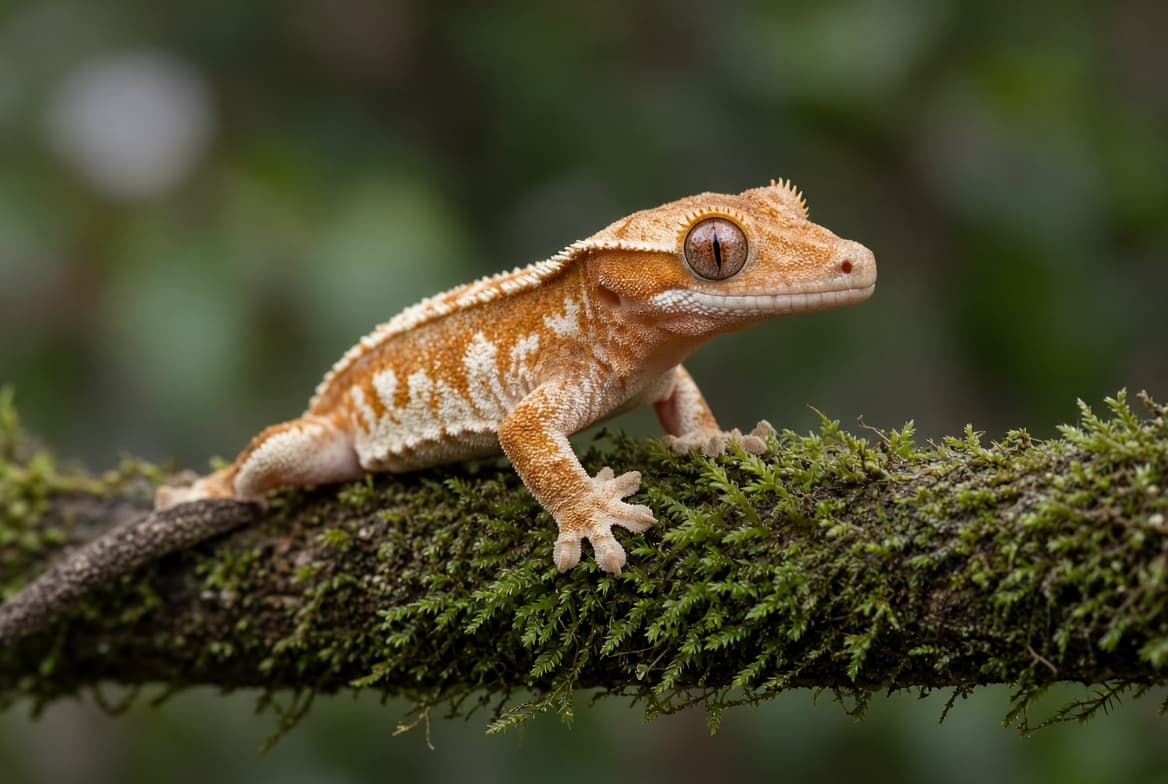
Crested Gecko
A night-active, tree-climbing gecko from New Caledonia that does well at room temperature. A tall enclosure, evening misting, and a complete powdered diet with some insects.
- Group
- Lizards
- Difficulty
- Beginner
- Adult size
- 5–9 in (13–23 cm) including the tail
- Lifespan
- 15–20 years
Evidence CExpert consensus or hobby source (lowest grade of its care-critical sections) · Reviewed 2026-10-24 by Novel Fauna · Evidence graded 2026-10-25
Overview
- Only expert, clinic or hobby sources
Crested geckos are one of the easiest lizards to keep well, mostly because they are happy at temperatures many homes already have 13. They are arboreal, active at night, and can jump surprisingly far between branches 12. Expect fifteen to twenty years with good care 2, and some go beyond twenty 1.
The two things people get wrong are heat (too much) and the tail (it does not grow back) 23.
Natural history
Crested geckos come from New Caledonia, in the southwest Pacific 14. The species was thought to be extinct until it was rediscovered on the Île des Pins in the 1990s 24. Since then it has become one of the most popular pet lizards in the world and is bred in the tens of thousands 4.
Adhesive toe pads let them climb glass and smooth leaves, and they use their tongues to clean their lidless eyes 12. Many wild adults have lost their tails 3.
Enclosure
- Only expert, clinic or hobby sources
- Go tall. Height matters more than floor space 12. An adult needs at least 24–30 inches of height on a 13 × 13 inch footprint, which is about a 20-gallon tall tank 1.
- Ventilation. A screen top for airflow and to prevent escape 12.
- Furnishings. Plenty of branches and live or artificial plants, with a hide on both the warm and cool sides, and a humid hide 1.
- Company. Never keep two males together; they fight 12. A male can live with females in a large enclosure, but they will breed 2.
- Placement. Keep the enclosure away from windows; window heat can be deadly 3.
Temperature & lighting
- Only expert, clinic or hobby sources
| Zone | Target |
|---|---|
| Daytime | 72–80°F 3; a warm side of 78–82°F 1 |
| Cool side / night | not below 65°F 1 |
| Danger | above 85°F stresses crested geckos 3 |
Most homes need little or no added heat. If you do add heat, use a thermostat and check temperatures with a digital probe or infrared thermometer 1.
Crested geckos have been raised for years without UVB, but current veterinary advice supports a low-level UVB tube (a "5.0" bulb) for 10 to 12 hours a day 12. UVB helps them make vitamin D3 and use calcium, which protects against metabolic bone disease 12. At night, keep it dark 2.
Humidity
- Rests on a single source
- Only expert, clinic or hobby sources
Keep humidity at 50 to 70%, ideally 60 to 70% 1. Mist once or twice a day, preferably in the evening when the gecko wakes up, and let the enclosure dry out partway between mistings 1. A digital hygrometer and a humid hide make this easy 1.
Substrate
- Rests on a single source
- Only expert, clinic or hobby sources
Because crested geckos spend most of their time off the ground, the risk of swallowing substrate is lower than in ground-dwelling lizards 1. Coconut fiber, peat moss or a soil and organic mix all work for a naturalistic setup. Avoid coconut husk chips for geckos under a year old 1.
Diet & supplementation
- Only expert, clinic or hobby sources
Crested geckos are omnivores 12.
- Complete powdered diet. Commercial crested gecko diets are mixed with water and offered a few times a week 13. These are balanced and do not need extra supplements 3.
- Insects. Offer gut-loaded crickets or roaches as a supplement, no larger than the space between the gecko's eyes 13. Chicago Exotics feeds adults powder twice a week and insects twice a week 3.
- Supplements. If insects make up much of the diet, dust them with phosphorus-free calcium 3–4 times a week and a multivitamin once a week 13.
- Do not leave crickets loose in the enclosure, especially with hatchlings; they can injure the gecko 3.
Handling & temperament
Crested geckos can be handled gently once settled in 2. Handle them low, over a soft surface, because they jump 2. Never hold or restrain a crested gecko by the tail. They drop it easily, and unlike many lizards the tail will not grow back 23. Keep handling short while the gecko is shedding 2.
Wash your hands after handling the gecko or its habitat. Reptiles can carry Salmonella, and young children, older adults and people with weakened immunity are at greater risk 25.
Health
- Only expert, clinic or hobby sources
Common issues
- Metabolic bone disease from too little calcium or vitamin D3, often seen as a kinked spine, soft jaw or weak legs 123.
- Heat stress when the enclosure climbs past the mid-80s °F 3.
- Shedding problems when humidity is too low 1.
- Tail loss from rough handling 23.
When to see a vet
Call an exotic-animal vet if your gecko stops eating for more than a week, has stuck shed that will not come off after soaking, breathes noisily or has mucus in its mouth 6. Open-mouth breathing, limp or oddly angled limbs, large open wounds or an unresponsive animal are emergencies 6.
Breeding overview
Crested geckos breed readily in captivity, which is why the hobby supports such large captive-bred numbers 4. If you keep a male with females, they will breed 2. Do not pair males together 12. A gravid female that strains, goes weak or has a prolapse needs a vet 6.
Legal & ethics
- Rests on a single source
Pet crested geckos are captive bred, and the hobby population now far outnumbers what was known in the wild when the species was rediscovered 4. Buy from a breeder who can tell you the hatch date and parents, and check your state and city rules before you buy or breed.
Sources
- Crested Gecko Care · Tree of Life Exotic Pet Medical Center
- Crested Gecko Care Sheet · PetMD
- Crested Gecko Care · Chicago Exotics Animal Hospital
- Correlophus ciliatus · The Reptile Database
- Salmonella, Feeder Rodents, and Pet Reptiles and Amphibians · U.S. Food and Drug Administration
- When Should My Reptile See a Veterinarian? · Tree of Life Exotic Pet Medical Center
Last reviewed 2026-10-24 by Novel Fauna. This guide is general husbandry information, not veterinary advice. When an animal is sick, see a veterinarian experienced with exotic animals.
Revision history
- Library: 50 cited care guides, /library/[slug] route, coming-soon cards, SLUGS.txt synced to species.guide_slug
228ce54 - WIP: library guides (lizards)
478b100
Evidence grades: Novel Fauna editorial: source classification, not yet expert-reviewed, 2026-10-25. What the grades mean.