Ceratophrys cranwelli · Ceratophryidae
Pacman Frog
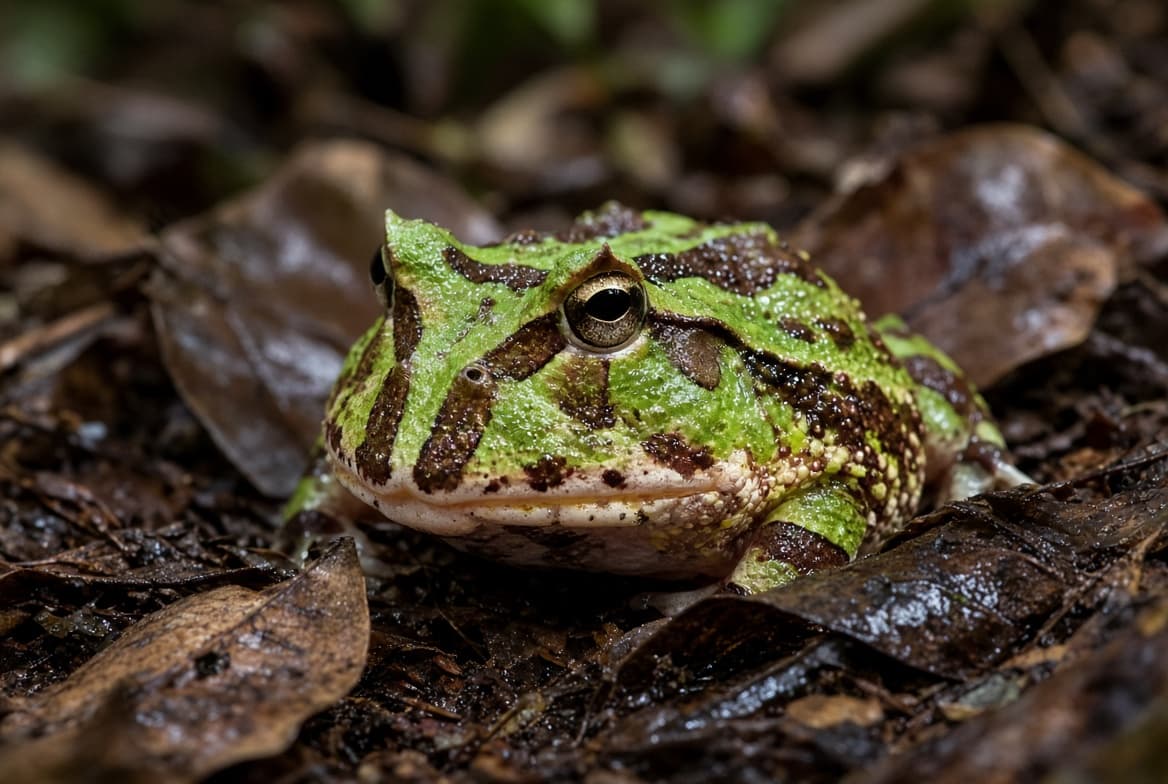
Cranwell's horned frog, a round, big-mouthed ambush predator from South America's Gran Chaco. It spends most of its life buried to the eyes in damp substrate. Easy to house and fun to feed, but best watched rather than handled.
- Group
- Frogs & toads
- Difficulty
- Beginner
- Adult size
- males 3–4 in; females 4–8 in
- Lifespan
- 10–15 years with good care
Evidence CExpert consensus or hobby source (lowest grade of its care-critical sections) · Reviewed 2026-10-24 by Novel Fauna · Evidence graded 2026-10-25
Overview
The "Pacman" frog is Cranwell's horned frog, named for its huge mouth and appetite 12. It's a squat, round frog with a broad head and a hornlike ridge over each eye. Colors range from green and yellow to brown, and the hobby also breeds red, orange and albino forms 23. Males are 3 to 4 inches long and females 4 to 8 inches 3. With good care they live 10 to 15 years 3. Pacmans settle in quickly and don't need much space, which makes them a good beginner amphibian 3.
Natural history
- Rests on a single source
Cranwell's horned frogs live only in the Gran Chaco of Argentina, Paraguay, Bolivia and Brazil 2. It's a land of thorn forest, palm savanna and seasonal wetlands. They are nocturnal sit-and-wait predators that stay still for hours, then strike. Hooked teeth and fang-like points on the jaw hold prey, and they'll even eat each other 2. In the dry season they bury themselves and estivate for months until the rains return 2. Wild frogs often live only 1 to 4 years, but captives can live much longer 2.
Enclosure
- Size. A 10-gallon terrarium is the minimum for one frog, and bigger is better for adult females 1.
- Front-opening tanks make feeding and cleaning easier 1.
- Hides. Offer one or two, though most pacmans simply bury themselves 1.
- Water. A shallow dish large enough to soak in, filled with dechlorinated water 1.
- One per enclosure. They're cannibalistic 2.
Temperature & lighting
- Rests on a single source
- Only expert, clinic or hobby sources
| Target 1 | |
|---|---|
| Ambient | 75–82°F |
| Warm side | 82–85°F |
| Night | 72–75°F |
Use a low-wattage ceramic heat emitter or a heat pad on the side of the tank, not underneath, and check with digital thermometers 1. UVB isn't strictly required but supports calcium metabolism and overall health. Keep a 12-hour day on a timer 1.
Humidity
Keep humidity at 60 to 80%, with good ventilation to prevent mold and bacteria 1. Amphibian skin absorbs water and anything in it. Use water free of chlorine, chloramine, ammonia, nitrite, pesticides and heavy metals. Treat tap water with a dechlorinator, and don't use distilled water 4.
Substrate
- Rests on a single source
- Only expert, clinic or hobby sources
Provide 3 to 4 inches of moisture-holding substrate such as coconut fiber, cypress mulch or a bioactive soil mix 1. Keep it damp but not soaking 1.
Diet & supplementation
- Staples. Appropriately sized insects, no wider than the frog's head 1.
- Treats. Pinky mice for adults only, and sparingly, since they cause obesity and liver problems 1.
- Adults. Feed 2 to 3 times a week 1.
- Calcium. Dust insects with calcium carbonate at every other feeding 1. Insect-only diets without supplements are a leading cause of metabolic bone disease in amphibians 5.
- Avoid substrate in meals. Feed off loose substrate to avoid impaction 1.
Handling & temperament
Pacmans have sharp teeth and readily bite, so they're best watched rather than handled 3. Human skin oils and bacteria can harm their absorbent skin. If you must handle one, use moistened, powder-free gloves 13. Frogs can carry Salmonella, so wash your hands after touching the frog, its water or its enclosure 7.
Health
Common issues
- Obesity. Pacmans will overeat if allowed, so watch portions 1.
- Impaction from swallowed substrate 1.
- Metabolic bone disease. Soft or deformed jaw, fractures and a curved spine 5.
- Retained shed when humidity is too low 1.
- Infections. Bacterial and fungal infections, including "red leg," usually follow poor water quality, diet, crowding or hygiene 6.
When to see a vet
See a vet experienced with amphibians for red or swollen legs or belly, weakness, loss of balance, skin color changes, lumps, a soft jaw or weight loss 56.
Breeding overview
- Rests on a single source
In the wild, males call with a horn-like note during the rainy season, November to April, and females lay eggs in temporary pools 2. The tadpoles are carnivorous and cannibalistic 2.
Legal & ethics
- Rests on a single source
Wild Cranwell's horned frogs face severe habitat loss in the Gran Chaco, and overcollection for the pet trade is a concern. Choose captive-bred frogs and never release one 2.
Sources
- Pacman Frog Care · Tree of Life Exotic Pet Medical Center
- Cranwell’s horned frog · Smithsonian's National Zoo and Conservation Biology Institute
- Pacman Frog Care Sheet · PetMD
- Housing for Amphibians · Merck Veterinary Manual
- Nutritional Diseases of Amphibians · Merck Veterinary Manual
- Common Infectious Diseases of Amphibians · Merck Veterinary Manual
- Salmonella, Feeder Rodents, and Pet Reptiles and Amphibians · U.S. Food and Drug Administration
Last reviewed 2026-10-24 by Novel Fauna. This guide is general husbandry information, not veterinary advice. When an animal is sick, see a veterinarian experienced with exotic animals.
Revision history
- Library: 50 cited care guides, /library/[slug] route, coming-soon cards, SLUGS.txt synced to species.guide_slug
228ce54
Evidence grades: Novel Fauna editorial: source classification, not yet expert-reviewed, 2026-10-25. What the grades mean.